
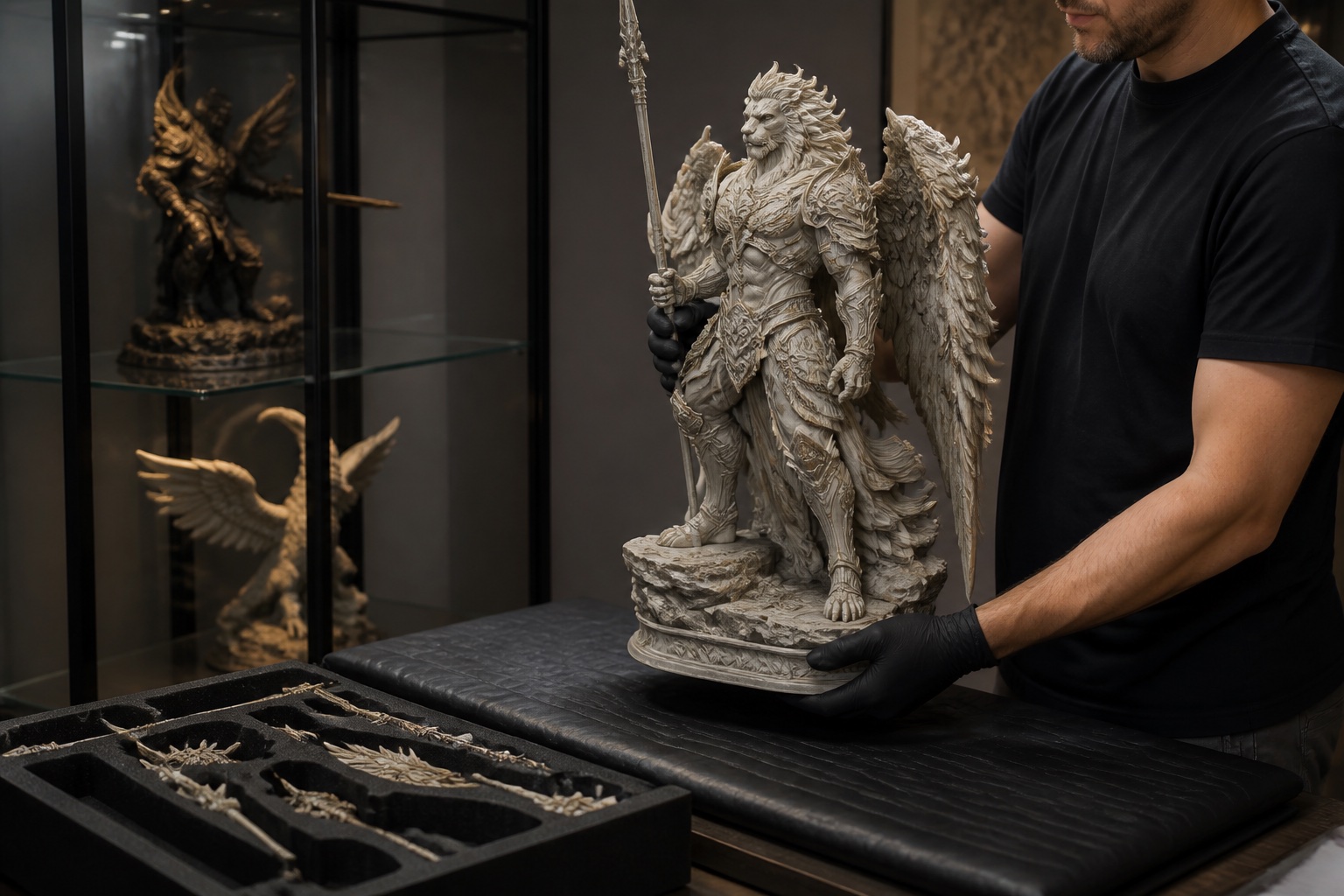
A move is the single most concentrated risk a premium statue collection will face. Months of stable display conditions count for nothing if a resin centerpiece spends four hours unrestrained in the back of a warm van. The damage that happens in transit is mechanical and abrupt, and it usually announces itself only after the last carton is opened.
This guide covers how to pack a statue for moving from the outbound side: deciding what comes apart, sourcing cartons when the original box is gone, choosing packing materials that will not mark paint, loading a vehicle, and re-inspecting at the destination. It assumes the collection is already assembled and on display.
Two related routines are documented elsewhere and are not repeated here. The statue preservation guide covers light, humidity, dust and the two-person handling routine, and the unboxing and inspection checklist covers inbound delivery and damage evidence. Read both before starting a pack-down; this article assumes that handling discipline and builds the transport plan on top of it.
Decide what comes apart before anything is wrapped
Work from the manufacturer's assembly instructions, not from memory of how the piece went together. Reverse the documented assembly order exactly. Anything the instructions describe as removable — portraits, arms, weapons, capes, effects parts, magnetized accessories, the figure's connection to its base — is usually safer moved as a separate, individually supported component than left cantilevered on an assembled statue.
Leave a piece assembled only when disassembly is not documented, when a join was glued at the factory, or when taking it apart would put more stress on it than the drive will. A short, fully seated peg inside a heavy torso is often best left alone. A thin blade extending eight inches past the silhouette is not.
Two constraints are worth recording before the first part comes off. The Canadian Conservation Institute's guidance on physical forces describes objects having resonant frequencies, so that a component can oscillate with greater amplitude than the vibration reaching it from the vehicle. Long, thin, weakly supported projections are exactly the shape that behaves this way. Sideshow's care guidance separately advises avoiding dynamic poses for long periods because it can put stress on the material, which is a reason not to leave a posed figure strained inside a carton for a week of storage.
Photograph every stage of disassembly as you go. Those photographs become the reassembly instructions at the destination, and they are the only reliable record of which cavity each accessory came from.
Why original packaging matters, and what to do when it is gone
Original packaging is engineered around the exact object. Fitted foam supports the piece at its structural points and leaves clearance around fragile projections, which no generic carton does by default. Sideshow's care guidance states that the original internal packaging and box are meant to protect the piece and that it is best to pack a collectible safely away in them. If the original cartons were kept, this section is short: reverse the documented packing order and move on.
When the box is gone, the objective is to reproduce what it did rather than to approximate it with volume. To repack a statue without original packaging, build the support in layers around the object's own geometry:
- Wrap the component in an inert, non-adhesive barrier layer that touches the paint — acid-free tissue, unbleached cotton sheeting or a smooth polyethylene foam sheet. Nothing printed, nothing with a textured embossing, nothing tacky. - Build a cushioning layer outside that barrier, sized so the component cannot shift in any direction. The CCI physical-forces guidance discusses cushioning thickness on the order of 50 mm for objects under roughly 75 kg, and notes that shock levels reaching an object vary enormously with drop height and packing type. - Fill and block the remaining void so nothing can settle during the drive. Voids are where a well-wrapped part turns into a projectile. - Support projections separately. A weapon, wing or cape edge should carry its own cushion rather than resting against the carton wall. - Consider a double-carton arrangement for the heaviest or most fragile pieces, which is the amateur equivalent of the double-crate system CCI describes.
Some materials are not safe against a finished surface. Do not place bubble wrap, newsprint, printed paper, packing peanuts, adhesive tape or shrink film in direct contact with paint, decals, fabric, silicone or a clear-coated finish. Bubble wrap can emboss a pattern into a soft finish under pressure and heat; ink transfers; peanuts migrate into a sculpt and abrade it; tape lifts paint when removed. Any of those materials may be fine in the outer layers, well away from the object.
Sequence, label and manifest every component
Pack base first, then body, then portraits, then accessories, keeping one statue's components together where possible. Heavy, dense parts go in the bottom of a carton; light and fragile parts go above them, never beneath.
Label each carton on at least two adjacent sides with the statue name, the component inside, the carton number in the set (for example, 2 of 4), which way is up, and whether the contents are fragile. A number on the top face alone disappears the moment the carton is stacked.
Keep a written manifest separate from the cartons — paper plus a copy stored off the phone that might get packed. For each statue, record every carton in its set, every component, the disassembly photographs, the edition or product identifier, and the pre-move condition. Without it, a missing hand at the destination is indistinguishable from a hand nobody has unpacked yet.
Load the vehicle around temperature and restraint
The vehicle matters as much as the cartons. CCI's physical-forces guidance is blunt about unrestrained cargo: packages can slide, bounce repeatedly, or fall out of a stack during transit, and impact is the result of something striking an object. Strap the load. Fill gaps so cartons cannot travel. Keep statue cartons off the floor deck where practical and away from the tailgate.
Temperature is the second transit risk, and it is easy to underestimate in a sealed vehicle. CCI identifies temperature that is too high, too low or fluctuating as distinct risks: many common plastics distort quickly and irreversibly above their heat distortion temperature, while acrylic paints that are leathery and tough at room temperature enter a glassy phase in the cold and become more vulnerable to impact. Sideshow's care guidance likewise calls for a temperature-controlled environment. The practical consequence when you transport a premium statue is that a climate-controlled passenger cabin is preferable to an unconditioned cargo box on a hot or freezing day, and that cartons should be allowed to reach room temperature before opening rather than being unpacked cold.
Do not leave a loaded vehicle parked in direct sun, and do not stage cartons in an unconditioned garage or storage unit overnight as a convenience. Moving a collectible statue is a same-day operation wherever the schedule allows it.
Unpack, acclimate and re-inspect at the destination
Prepare the destination before the first carton comes in. Clear a padded worktable, confirm the cabinet is level and rated for the assembled weight, and keep the pack-down photographs accessible. The display planning guide covers cabinet clearance and shelf load in detail, and the display case guide covers choosing a case on documented evidence.
Let cartons sit closed in the destination room until they reach room temperature. Then unpack in reverse manifest order, checking each component off the list as it comes out. Inspect before reassembly, not after: look for new cracks, chips, paint rub, lifted glue joints, bent projections and separated magnets, and compare against the pre-move photographs rather than against memory. Reassemble only from the manufacturer's instructions, on the padded surface, with a second person for anything large.
Keep the packing materials until the collection has been assembled, inspected and stable on display for a reasonable period. If the move was handled by a carrier, keep them until any claim window has closed.
Document condition for insurance before and after
Condition documentation is only useful if it predates the loss. Photograph each statue assembled and in good light before disassembly: front, back, both sides, the base and edition markings, and close views of delicate joins and any pre-existing flaw. Repeat the set after reassembly at the destination. Two dated sets, before and after, are what turn a claim from an assertion into a record.
Store the manifest, photographs, purchase records, product codes, certificates and assembly instructions together, with a copy kept somewhere other than the room holding the collection. Confirm in writing what a mover's or carrier's liability actually covers for high-value collectibles before the truck is loaded; standard coverage is frequently calculated by weight rather than value. If a carrier handled the move and something arrives damaged, document it and raise it through that carrier's stated process within its deadline.
Retailer support is a separate matter and is generally tied to delivery, not to a later relocation. Sideshow's published direct return and exchange terms run from delivery and ask that returns include the original packaging and outer shipping cartons; those terms address an inbound order, not damage that occurs during a collector's own move. Read the applicable written terms rather than assuming.
DiecastFigures does not sell, ship, move, store or insure collectibles. Retailers, manufacturers, carriers and insurers control their own support, claims, coverage and warranty terms, and material-specific care requirements vary by product. Policies and links were reviewed September 2026; verify the current instructions for your exact pieces and the written terms of the party actually handling your move.
See an error? Request a correction.